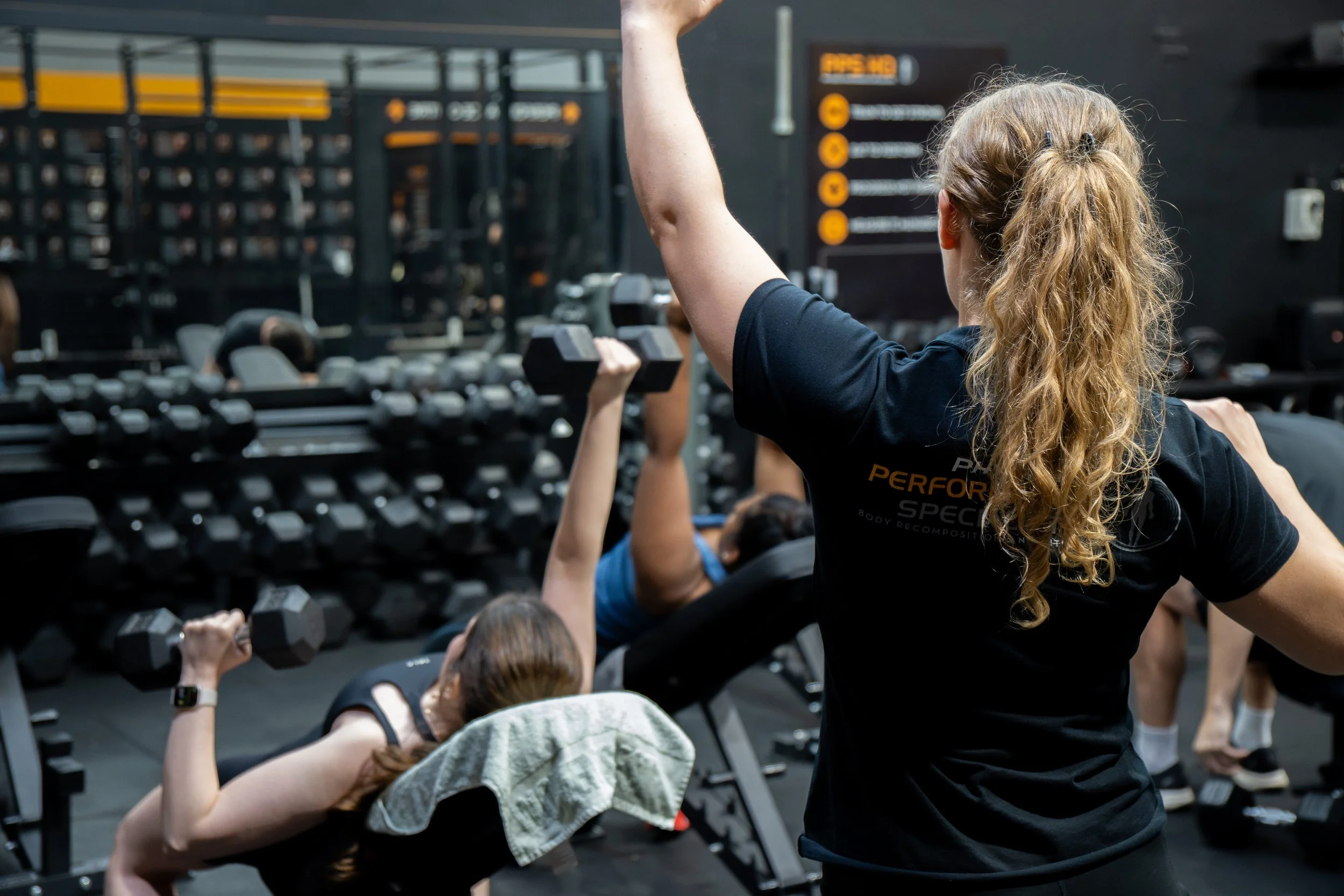
Small-group strength training is exactly what it sounds like. A coach, a group of people, and a structured strength program that everyone works through together.
The part that matters is the ratio. At PPS it is eight people to one coach, and everything about how we run the session is built around that number.
If you have only ever seen group fitness classes or one-on-one personal training, small-group strength sits somewhere in between, and it is not a compromise between the two. For a lot of people it produces better results than either.
The 8:1 model
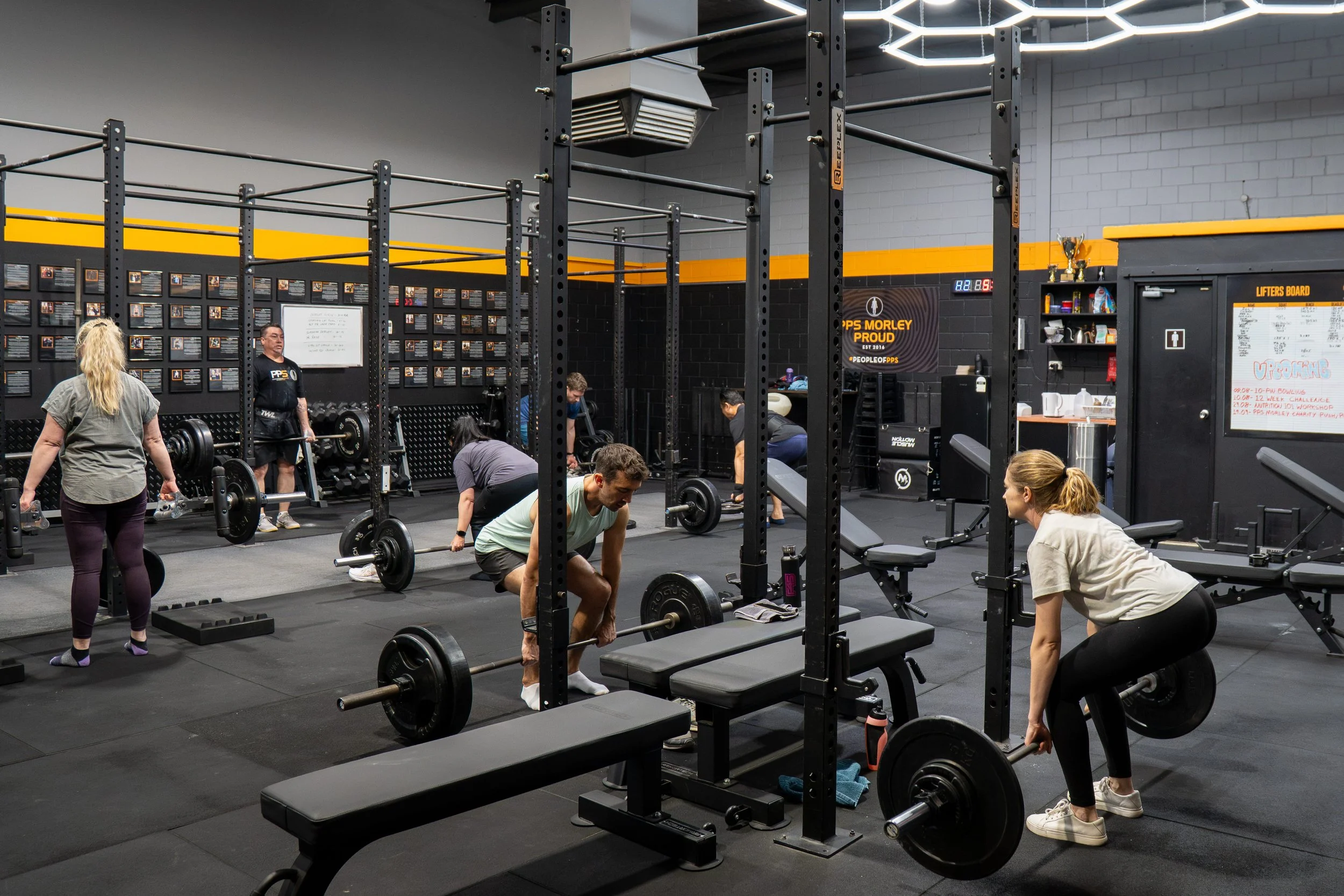
Eight is not an arbitrary cap. It is the largest group where a coach can still watch everyone lift and say something useful.
Below eight, you pay for attention you don't need once you know the movements. Above eight, the coach becomes a timekeeper. They can tell you when to start and stop, but they cannot tell you that your bar path is drifting forward or that you have another two reps in the tank.
Eight is the number where coaching still happens.
How a session actually works
Everyone runs the same program. The session has a set structure, a set list of movements, and everyone in the room works through it together.
Personalisation happens in two places: load and movement selection. Two people can do the same exercise on the same day with completely different weights, and one might be doing a regression or progression of that movement instead.
If your shoulder does not like overhead pressing, you press at an incline. If you cannot get depth in a back squat yet, you squat to a box or use a goblet variation. If you have been training for three years and the standard version is easy, your coach gives you the harder one. Same session, different execution, appropriate to you.
This is the bit people miss when they compare programs on paper. The program is not what makes training individual. The loading and the movement variation are.
You log your weights. Every session, every lift. This isn't admin for its own sake. It is the mechanism.
Progressive overload drives everything. The reason you log the weights is so that next time you have to beat them, whether that means more load, more reps, or better execution at the same load. A program that does not progress is just exercise. Progression is what changes your body.
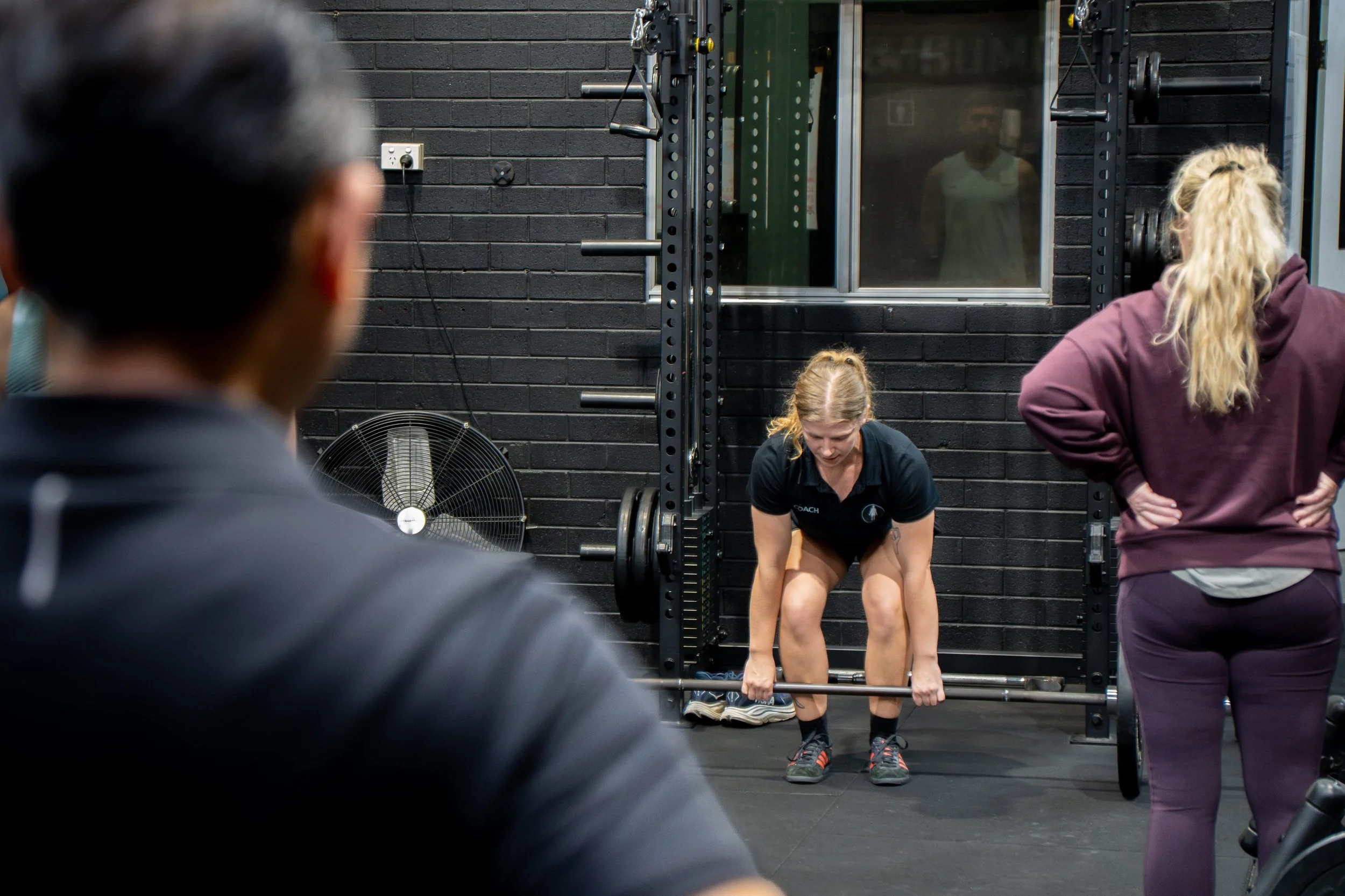
Your coach is coaching. Cues on technique, adjustments to your setup, calls on when to add weight and when to hold. That is the job, and with eight people, it is a job that can actually be done.
Small-group strength training is not a group fitness class
This gets confused constantly, so worth being direct about it.
A group fitness class gives you a different workout every time. It is designed to make you sweat, and it is usually not tracked. You book in when you feel like it, you get whoever is teaching that day, and next week's session has no relationship to this week's.
Small-group strength training runs a program. This week builds on last week. Your weights are recorded and expected to move. You train the same days, at the same times, with the same coach and the same people. There is no booking system to fight with, because your spot is your spot.
One is a workout. The other is training.
The benefits of training in a group versus 1:1
One-on-one coaching is excellent, and sometimes it is the right answer. But groups offer real advantages that one-on-one coaching can't, and they get overlooked because the industry has spent twenty years selling 1:1 as the premium option.
The room pulls you along
You will train harder next to seven other people working harder than you will alone with a coach. Not because anyone is competing, but because effort is contagious. On the days you turn up flat, the room carries you. Nobody has ever been talked into a genuinely hard set by willpower alone at 6 am on a Tuesday.
Nobody gets left behind
Because everyone is on the same program, the group moves together. You are never the person still on set two while everyone else has packed up, and you are never waiting around bored. That shared pace is what makes the room feel like a team rather than eight people doing separate things near each other.
You stop being the odd one out
Most people who walk into a commercial gym feel like everyone else knows something they do not. In a small group where everyone is doing the same session, that feeling disappears in about two weeks. You are not the beginner. You are one of eight people doing the same thing at different weights.
The people become the reason you turn up
This is what decides your results at the twelve-month mark. When you train with the same seven people every week, they notice when you are not there. Missing becomes something you have to actively do rather than something that just happens. That is worth more than any program.
Consistency is built into the structure
Same days, same times, same coach, same group, every week. You do not decide whether to train. It is in your calendar the way work is in your calendar. One-on-one is usually more flexible, and flexible is exactly the problem. A session you can move is a session you can move again.
It is about half the price of one-on-one, and you may get better results
Not "almost as good for less money". Potentially better.
Here is the logic. Results come from doing the right thing consistently for a long time. Small group costs roughly half of one-on-one, which means most people can sustain it for years rather than a few months. Add the accountability of a fixed group and the effort the room pulls out of you, and the total amount of good training you accumulate is often higher than it would be at double the price with nobody else in the room.
Two years of consistent small-group training beats four months of one-on-one. That is not a close call.
When one-on-one is still the right call
We would rather be straight with you.
If you are working around a significant injury, coming back from surgery, or dealing with a condition that needs constant supervision, pay for one-on-one. If the thought of training in front of seven other people is the thing stopping you from starting at all, start one-on-one and move across when you are ready. If you are preparing for something specific with a deadline, one-on-one is faster.
For everyone else, and that is most people, the group is the better option.
What makes PPS different
Plenty of gyms in Perth run small groups. The differences are in the details.
It is structured like one-on-one coaching. You get coaching cues every session. The coach watches your lifts, not a clock. That's why we cap it at eight.
Everyone moves at the same pace. The group works through the session together. Nobody is left behind, and nobody is held up.
Your weights are tracked and progressed. Progressive overload is not an optional extra. It is the method.
You do not book classes. You train the same days and times each week with the same coach and the same group. Turning up stops being a decision.
It is strength training and body composition, deliberately. No cardio circuits, no HYROX, no CrossFit, no boxing. We do one thing.
Private, appointment-only gyms. Four locations across Perth: Morley, Subiaco, Wanneroo and Yangebup. No queuing for a rack, no walking into a room full of strangers.
Frequently asked questions
How many people are in a session? Eight maximum. That cap does not move.
If everyone does the same program, how is it personalised? Through load and movement selection. Your weights are set for you, and your coach gives you a regression or progression for any exercise that doesn't suit your body, injury history, or experience level.
Is this a class? No. Classes give you a different workout each time with no tracking and no progression. This is a program that builds week on week, with your numbers recorded.
Do I need training experience to start? No. Most of our members had never trained properly before they joined. The 8:1 ratio exists precisely so that beginners get coached.
How often should I train? Two to three sessions per week for most people. Three is the sweet spot for changing your body composition.
What if I cannot make my usual time? Talk to your coach. The fixed schedule is the point, but life happens, and we work around it.
What if I have an injury? Tell us at your consult. Our coaches are experienced in programming around common injuries, and we will always ask you to get clearance and advice from your physio or GP first.
How do I get started? Fill in the enquiry form, and we will book a consult call. If it is a mutual fit, you come in for an onboarding session where we assess your movement, set your starting loads and take your baseline measurements before your first group session.